

February 2022 Interview with Rick Hwang, President of Rugged & Video Solutions Business Group at Getac

Getac's Mighty Class of 2021
January 2021 Interview with Rick Hwang, President of Rugged & Video Solutions Business Group at Getac

Getac V110 at Cirque du Soleil

Getac 25th Anniversary at 2014 Miramar Air Show

Getac FedEx TechConnect

TDI Panamericana 2011 team using Getac V100 on 16,000 mile endurance challenge
|

|

|
|
GETAC UX10
AI-ready, fully rugged high-performance 10-inch Windows tablet offers great performance, superior battery life
By Conrad H. Blickenstorfer, photography by Carol Cotton
Now in its fifth generation, Getac originally introduced the rugged 10-inch UX10 Windows tablet in the summer of 2019. Designed to meet the demanding requirements of emergency service and public safety personnel worldwide, the UX10 has also proven suitable for numerous other mission-critical applications in utilities, field services, industrial manufacturing, and beyond. The device was conceived as a detachable laptop — usable either as a standalone tablet or, with its optional keyboard dock, as a fully functional laptop replacement.
The latest iteration of the UX10 is engineered to meet Microsoft's stringent Copilot+ PC requirements, enabling support for built-in AI features such as real-time language translation, AI-assisted image creation, enhanced search, and other emerging AI-driven tools and applications.

The UX10 was initially Getac's answer to the Panasonic Toughbook 20, much as the larger Getac K120 was introduced to compete with Panasonic's Toughbook 33. All of these were hybrid solutions consisting of a self-contained tablet paired with an optional detachable keyboard that added substantial functionality and connectivity. Panasonic referred to its design as a detachable laptop, whereas Getac positioned the UX10 as a rugged tablet with enhanced versatility. Panasonic has since replaced the Toughbook 20 with the closely related Toughbook G2, which remains in production.
 This class of design enables operation as both a true tablet and a true laptop. As such, the UX10 fulfills two important roles within Getac's lineup. This class of design enables operation as both a true tablet and a true laptop. As such, the UX10 fulfills two important roles within Getac's lineup.
First, it serves as a direct competitor to devices such as Dell's Pro Rugged 10 Tablet, Panasonic's Toughbook G2, Durabook's R10, and comparable 10-inch rugged 2-in-1 systems from DT Research and others.
Just as importantly, in its fifth generation the UX10 provides Getac with a state-of-the-art 10-inch-class rugged platform that now incorporates substantial AI processing capability and satisfies Microsoft's Copilot+ PC requirements — a certification that may evolve over time but currently represents a meaningful competitive differentiator.
In its UX10 press release, Getac did not emphasize the optional keyboard that transforms the device into a full-function 2-in-1 hybrid. It is clear, however, that the UX10 paired with its purpose-built keyboard dock (shown to the left) offers substantially more capability than a tablet used with a generic third-party USB or Bluetooth keyboard.
All hybrids involve compromise, attempting to combine the strengths of different design approaches within a single device. They are not pure expressions of either form factor, but they address the needs of users who require both. The UX10 functions as a fully capable standalone tablet and, when equipped with its optional keyboard dock, becomes a complete laptop solution — albeit one that differs in design philosophy from a traditional clamshell notebook.
So what do you get with the Getac UX10?
The fifth-generation Getac UX10 remains a rugged tablet that combines flexibility with substantial computing power in a remarkably compact package. With a footprint of just 10.8 x 7.5 inches, it is small enough to fit almost anywhere. Despite its reinforced construction, the device measures less than an inch in thickness and weighs only 2.7 pounds.
Unlike earlier rugged tablets in this class — which often traded performance for acceptable off-grid battery life — the UX10 largely avoids that compromise. Equipped with Intel Core Ultra Series 2 processors and modern platform technology, it delivers strong performance while also achieving impressive runtime.
What general size class does the UX10 occupy? Its 10-inch display places it in the same physical category as Apple's 10-inch-class iPad models and numerous Android-based consumer and enterprise tablets. When used with the optional keyboard as a notebook replacement, however, the 10-inch screen is on the small side, as conventional laptops typically offer displays between 13 and 16 inches.
The table below illustrates where the UX10 fits within Getac's expanding lineup of rugged tablets:
|
Getac Rugged Windows Tablets: Where the UX10 fits in
|
|
Model
|
UX10
|
F120
|
V120
|
K120
|
A140
|
|
|

|
|
Display size
|
10.1-inch
|
12.2-inch
|
12.2-inch
|
12.5-inch
|
14.0-inch
|
|
Resolution
|
1920 x 1200
|
1920 x 1200
|
1920 x 1200
|
1920 x 1080
|
1920 x 1080
|
|
Pixels/inch
|
224 ppi
|
186 ppi
|
186 ppi
|
176 ppi
|
157 ppi
|
|
Luminance
|
1000 nits
|
1200 nits
|
1000 nits
|
1200 nits
|
800 nits
|
|
Size (inches)
|
11.00 x 7.65 x 0.92
|
11.80 x 8.15 x 0.87
|
11.89 x 8.82 x 1.41
|
12.97 x 9.37 x 0.94
|
14.58 x 9.76 x 1.28
|
|
Volume
|
77.4 cu-in
|
78.0 cu-in
|
147.9 cu-in
|
114.2 cu-in
|
182.1 cu-in
|
|
Weight
|
2.53 pounds
|
3.11 pounds
|
4.63 pounds
|
3.75 pounds
|
5.1 pounds
|
|
CPUs
|
Core Ultra V-Series
|
Core Ultra V-Series
|
Core Ultra H-Series
|
13th gen Core
|
Core Ultra Series 1
|
|
CPU Code
|
Lunar Lake
|
Lunar Lake
|
Arrow Lake
|
Raptor Lake
|
Meteor Lake
|
|
Max RAM
|
32GB LPDDR5x
|
32GB LPDDR5x
|
64GB DDR5
|
64GB DDR5
|
32GB
|
|
Max storage
|
2TB PCIe NVMe SSD
|
2TB PCIe NVMe SSD
|
2TB PCIe NVMe SSD
|
2TB PCIe NVMe SSD
|
1TB PCIe SSD
|
|
Op. temp
|
-20° to 145° F
|
-20° to 145° F<
|
-20° to 145° F
|
-20° to 145° F
|
-6° to 140° F
|
|
IP rating
|
IP66
|
IP66
|
IP66
|
IP66
|
IP65
|
The UX10 is available with 16GB or 32GB of LPDDR5x memory and solid-state storage configurations ranging from 256GB to 2TB of PCIe NVMe SSD.
The 10.1-inch IPS display (as used across recent Getac platforms) offers 1920 x 1200 pixel resolution, resulting in a sharp 224 pixels per inch. Rated at 1,000 nits of luminance — and measuring nearly 1,200 nits in our testing — the screen remains clearly viewable even in bright outdoor conditions, which has effectively become the standard for this class of rugged tablets. The display supports 10-point capacitive multi-touch, includes a hard-tip stylus, and is available with an optional active digitizer.
Battery capacity is always a balancing act in tablet design due to space and weight constraints. Getac did not minimize battery size in pursuit of the lowest possible starting weight. The standard UX10 includes a 47.25Wh battery, with an optional 99.8Wh high-capacity pack available. Hot-swapping remains supported via an optional bridge battery.
Given its intended field deployments, the UX10 prioritizes functionality and performance over minimal weight. The tablet with keyboard dock weighs slightly over five pounds, while the tablet alone starts at approximately 2.65 pounds. Weight naturally varies depending on configuration; our well-equipped review unit weighed 3.75 pounds, including the optional hard handle, bolt-on SmartCard reader, and 99.8Wh extended battery.
Compared to typical consumer or enterprise tablets, the UX10 feels substantially more robust and structurally reinforced. At the same time, it maintains a purposeful, cohesive design in which form clearly follows function. The four corners appear engineered to accept optional screw-on protective bumpers and also serve as mounting anchors for the sturdy optional carry handle. Below is a look at the UX10 from the top and from all four sides:
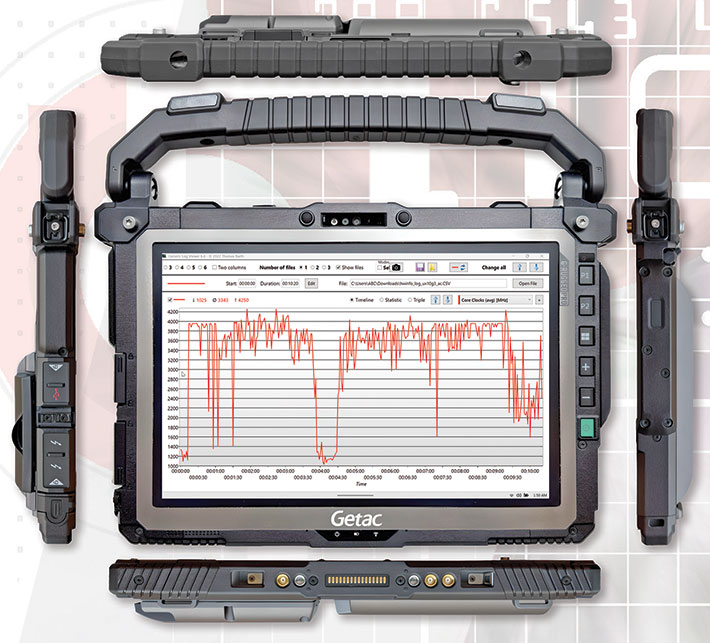
Sealing and protection of ports are essential in rugged computers. The UX10 employs substantial polycarbonate port covers whose integrated seals press firmly against or into the metal chassis to create a secure and tight barrier against dust and moisture. Proper alignment is important when closing the covers, but once seated correctly they provide a dependable sealing solution.

Above is a top view of the UX10 with the carry handle rotated aside to expose the ports area. Our review unit included the optional HDMI port. In its place, customers may choose from six alternative configurations, including a barcode scanner, an HF RFID antenna, a microSD card slot, an RS-232 serial port, an RJ45 LAN port, or a USB-A 2.0 port.
 The rear of the UX10 offers additional customization flexibility. The rear of the UX10 offers additional customization flexibility.
Available options include an HF RFID reader, a Smart Card reader, a bridge battery, or a combined bridge battery/Smart Card reader module. Also available is the high-capacity main battery rated at 99.8Wh — more than twice the capacity of the standard battery.
In total, the UX10 provides three expansion areas, each capable of accepting one of several module options.
This modular approach allows the system to be configured for a wide range of deployment scenarios. At the same time, because each expansion bay accommodates only a single module, customers may need to prioritize certain features over others.
Below are the three optional rear-mounted modules for the UX10. From left to right: the combined bridge battery and Smart Card reader module, the Smart Card-only module, and the bridge battery module that enables hot-swapping of the primary battery.

Exemplary design
There are tablets — and there are tablets. Some are little more than slim enclosures housing a circuit board and display. Others are intricate, tightly integrated systems in which every component serves a deliberate purpose. The Getac UX10 belongs in the latter category.
A lightweight yet structurally substantial magnesium frame provides rigidity, while the multi-piece polymer enclosure is engineered with clear functional intent. Nothing appears incidental; each structural and cosmetic element contributes either to durability, serviceability, ergonomics, or system integration.
The level of execution is noteworthy. The UX10 exemplifies how form can follow function without sacrificing visual coherence. The design conveys purpose and precision both externally and internally. We have rarely encountered a rugged tablet in which as much attention was paid to unseen internal structure as to visible exterior elements. If there is an antonym for "generic" in industrial design, the UX10 comes close.
Even on the rear of the unit, material choices reflect deliberate engineering. The polymer surface has a hard, highly scratch-resistant, powder-like finish that closely resembles powder-coated magnesium, lending both durability and a refined appearance.
Below are some of the details that showcase this impressive attention to every detail:

Clockwise and starting from the upper left, you can see:
 - Thermal system. A close-up of the compact cooling fan and heat exchanger used in this latest-generation UX10. Together with the tablet's array of sensors, the system forms a sophisticated thermal management architecture that dynamically balances performance and energy efficiency across varying workloads and ambient conditions.
- Carry handle mounting. The optional carry handle is not a lightweight accessory fastened into plastic. It is anchored with four substantial bolts directly into the magnesium frame, providing structural integrity appropriate for field use.
- Expansion module interface. This view shows the area beneath the rear expansion module mounting plate. Communication modules and system storage reside here. Rather than relying on minimal shielding, RF protection is implemented via precision-fabricated metal enclosures secured with screws. In certain areas, thermally conductive materials serve a dual purpose — containing electromagnetic emissions while also channeling heat away from critical components to enhance reliability and longevity.
- High-capacity battery. The optional 99.8Wh battery can be installed or removed within seconds. Integrated five-LED charge indicators allow users to verify state of charge before insertion.
- Modular expansion design. Optional components such as integrated ports or barcode scanners are not loosely fitted or bonded in place. Each module is precision-engineered to ensure secure mechanical seating while allowing installation or removal without disassembling the entire system.
- Port protection. The protective port covers are clearly labeled, easy to operate, and secured with screws, allowing straightforward replacement if damaged in service.
Intel "Lunar Lake" Core Ultra Series 2 power
Like its larger F120 sibling, the fifth-generation Getac UX10 is powered by Intel "Lunar Lake" Core Ultra Series 2 processors, marketed as the Core Ultra 200V series. Lunar Lake represents Intel's latest architectural evolution in its mobile processor lineup and reflects the company's strong pivot toward AI-accelerated computing.
Selecting the appropriate processor is one of the most consequential decisions in mobile system design. Customers expect maximum performance, long battery life, minimal weight, and competitive pricing — objectives that rarely align perfectly. Every platform involves tradeoffs.
Historically, much of the UX10's appeal has been its ability to deliver substantial computing power in a compact 10-inch form factor. With each generation, Getac has positioned the UX10 near the top of its performance class. With this latest iteration, the company again advances performance, but the criteria have evolved.
 In earlier generations, processor comparisons largely revolved around clock speeds, core counts, and thread counts. Over time, graphics performance gained importance, leading to increasingly capable integrated GPUs. Now, with AI-driven utilities and applications becoming central to modern workflows, a third compute engine has taken on prominence: the NPU (Neural Processing Unit). In earlier generations, processor comparisons largely revolved around clock speeds, core counts, and thread counts. Over time, graphics performance gained importance, leading to increasingly capable integrated GPUs. Now, with AI-driven utilities and applications becoming central to modern workflows, a third compute engine has taken on prominence: the NPU (Neural Processing Unit).
NPUs are optimized specifically for AI inference workloads. Their performance is measured not in clock frequency, but in TOPS (Tera Operations Per Second), a metric reflecting parallel AI processing capability.
As Intel's architectures evolved, its traditional numbered "generation" branding became less indicative of underlying design changes. The 14th-generation Core family, for example, included both refreshed Raptor Lake processors and the newer "Meteor Lake" designs — branded as Core Ultra — which introduced integrated NPUs marketed as "Intel AI Boost."
Core Ultra Series 2 processors are segmented for different usage profiles. The H series targets performance-oriented systems, the U series addresses thin-and-light designs, and the V series emphasizes AI-optimized efficiency. In addition, some variants incorporate standard integrated graphics, while others feature the considerably more powerful Intel Arc architecture.
The result is a far more differentiated processor landscape than in previous generations — one in which CPU, GPU, and NPU capabilities must all be considered.

As is customary for Getac, the UX10 is offered with multiple processor configurations. All available options are mobile V-series Core Ultra 200V designs, clearly positioning the system as optimized for AI-accelerated mobile workloads.
The NPUs across all eight supported CPU variants meet Microsoft's Copilot+ PC requirement, delivering between 40 and 48 TOPS of dedicated AI acceleration. In addition, because many edge-AI applications leverage the GPU — either independently or alongside the NPU — each processor option integrates Intel Arc graphics capable of generating between 54 and 66 TOPS of AI compute performance on their own.
In aggregate, this makes the V-series-powered UX10, along with the similarly configured Getac F120, the most AI-capable lineup in Getac's portfolio in terms of peak theoretical TOPS. While certain higher-core-count "traditional" processors may offer greater conventional CPU throughput, they often provide significantly lower combined AI acceleration. For example, some 24-core mainstream designs peak at roughly 36 total TOPS, whereas V-series processors with just eight cores can reach combined AI throughput figures as high as 118 TOPS when NPU and GPU capabilities are considered.
The table below outlines the five processor options currently available for the Getac UX10 G5 and summarizes their key specifications.
|
Intel CPU
|
Core Ultra 7
|
Core Ultra 7
|
Core Ultra 7
|
Core Ultra 7
|
Core Ultra 5
|
Core Ultra 5
|
Core Ultra 5
|
Core Ultra 5
|
|
Model
|
268V
|
266V
|
258V
|
256V
|
238V
|
236V
|
228V
|
226V
|
|
Peak TOPS
|
118
|
118
|
115
|
115
|
97
|
97
|
97
|
97
|
|
P-Cores
|
4
|
4
|
4
|
4
|
4
|
4
|
4
|
4
|
|
Low Power E-Cores
|
4
|
4
|
4
|
4
|
4
|
4
|
4
|
4
|
|
Total Cores
|
8
|
8
|
8
|
8
|
8
|
8
|
8
|
8
|
|
P-cores Max Turbo
|
5.00 GHz
|
5.00 GHz
|
4.80 GHz
|
4.80 GHz
|
4.70 GHz
|
4.70 GHz
|
4.50 GHz
|
4.50 GHz
|
|
Smart Cache
|
12MB
|
12MB
|
12MB
|
12MB
|
8MB
|
8MB
|
8MB
|
8MB
|
|
Thermal Design Power
|
17/37 watts
|
17/37 watts
|
17/37 watts
|
17/37 watts
|
17/37 watts
|
17/37 watts
|
17/37 watts
|
17/37 watts
|
|
Integrated graphics
|
Intel Arc 140V
|
Intel Arc 140V
|
Intel Arc 140V
|
Intel Arc 140V
|
Intel Arc 130V
|
Intel Arc 130V
|
Intel Arc 130V
|
Intel Arc 130TV
|
|
GPU Peak TOPS
|
66
|
66
|
64
|
64
|
53
|
53
|
53
|
53
|
|
Graphics max speed
|
2.00 GHz
|
2.00 GHz
|
1.95 GHz
|
1.95 GHz
|
1.85 GHz
|
1.85 GHz
|
1.85 GHz
|
1.85 GHz
|
|
NPU Peak TOPS
|
48
|
48
|
47
|
47
|
40
|
40
|
40
|
40
|
|
Intel vPro
|
Enterprise
|
Enterprise
|
NA
|
NA
|
Enterprise
|
Enterprise
|
NA
|
NA
|
A review of the table highlights one immediately noticeable characteristic: the relatively modest core count. All UX10 processor options are limited to eight cores, whereas other Core Ultra Series 2 variants scale up to 24 cores. Some recently introduced Getac rugged systems likewise offer configurations with up to 16 cores. The distinction reflects targeted usage profiles. V-series processors emphasize a balanced, AI-centric architecture, while H-series systems — such as the Getac B360 G3 and the Getac V120 — prioritize higher CPU core and thread counts for compute-intensive workloads. That said, in practical field deployments, sustained performance under thermal and power constraints often matters more than peak multi-core throughput.
The V-series architecture combines NPUs that satisfy Microsoft's 40-TOPS Copilot+ PC requirement with high-performance Intel Arc graphics. For highly mobile platforms where power efficiency, thermal constraints, and edge-AI capability are critical, this configuration offers a compelling balance. It provides operational flexibility and readiness for emerging on-device AI, computer vision, and real-time analytics applications.
Despite the broad selection of CPU options, the differences among them are relatively incremental. All employ an eight-core, eight-thread configuration and include hardware-accelerated Intel Arc graphics. Variations lie primarily in clock speeds, cache sizes, memory ceilings, and GPU tiering, resulting in measurable but not dramatic performance differences. Ultra 7 variants incorporate Arc 140V graphics and therefore deliver somewhat higher vector and graphics throughput than Ultra 5 models, which utilize Arc 130V graphics.
How does the Getac UX10 G5 perform relative to its primary 10-inch rugged tablet competitors? The benchmark results below provide the answer:
|
Getac UX10 G5 Tablet vs 10-inch class rugged tablets
|
|
Company
|
Getac
|
Dell
|
DT Research
|
Juniper
|
Mobile Demand
|
|
Model
|
UX10
|
Pro Rugged 10
|
DT302RP
|
Mesa Pro
|
T1175
|
|
Year tested
|
2026
|
2026
|
2024
|
2024
|
2024
|
|
CPU Type
|
Intel Core Ultra
|
Intel Core Ultra
|
Intel Core
|
Intel Atom
|
Intel Core
|
|
CPU model
|
7 266V
|
7 268V
|
i7-1355U
|
i7-1165G7
|
i5-1335U
|
|
Display size
|
10.1-inch
|
10.1-inch
|
10.1-inch
|
10.1-inch
|
10.1-inch
|
|
Resolution (pixels)
|
1920 x 1200
|
1920 x 1200
|
1920 x 1200
|
1920 x 1200
|
1920 x 1200
|
|
Luminance
|
1,170 nits
|
1,090 nits
|
825 nits
|
841 nits
|
688 nits
|
|
Footprint (inches)
|
10.80 x 7.50
|
10.33 x 7.40
|
10.71 x 7.70
|
11.2 x 7.7
|
11.54 x 7.56
|
|
Thickness (inches)
|
0.88
|
1.00
|
0.79
|
1.20
|
0.67
|
|
Volume (cu-in)
|
71.3
|
76.7
|
65.1
|
103.5
|
58.5
|
|
Weight as tested (lbs.)
|
2.68
|
2.62
|
3.00
|
4.16
|
2.73
|
|
Operating temp
|
-20° to 145° F
|
-20° to 145° F
|
-14° to 140° F
|
-4° to 122° F
|
-14° to 122° F
|
|
Ingress Protection rating
|
IP66
|
IP66
|
IP65
|
IP68
|
IP65
|
|
PassMark 6.1
|
9,227
|
8,295
|
8,534
|
10,257
|
8,240
|
|
PassMark 9.0
|
6,106
|
7,240
|
5,235
|
5,482
|
5,067
|
|
CrystalMark
|
596,593
|
629,036
|
463,183
|
536,918
|
465,528
|
|
PCMark 10 Overall
|
7,625
|
7,643
|
5,235
|
5,096
|
4,801
|
|
PCMark 10 Disk
|
1,658
|
2,007
|
2,111
|
2,310
|
1,838
|
|
PCMark 10 Battery
|
25:44 hrs
|
13:42 hrs
|
5:43 hrs
|
13:49 hrs
|
6:01 hrs
|
|
Battery watt-hrs
|
99.8
|
36.0
|
43.3
|
86.4
|
64.0
|
|
Watt-hrs/hour
|
3.88
|
2.63
|
7.57
|
6.25
|
6:01
|
|
3DMark TimeSpy
|
4,069
|
4,545
|
1,231
|
1,604
|
1,237
|
|
GeekBench 5 single core
|
2,031
|
2,885
|
1,619
|
1,504
|
1,565
|
|
GeekBench 5 multi core
|
9,599
|
11,377
|
5,528
|
5,562
|
4,810
|
|
GeekBench 5 Open CL
|
33,127
|
31,724
|
12,535
|
18,227
|
12,377
|
What do the benchmarks show? Primarily that system performance is a constantly moving target. What represented top-tier performance only a short time ago can quickly become baseline. Progress is no longer driven solely by higher clock speeds, increased core counts, or smaller lithography. Modern platforms derive performance from a coordinated combination of CPU, GPU, and NPU resources. As a result, we observe substantial gains in certain workloads, while others show more incremental improvement.
It is important to emphasize that benchmark tables such as the one above should not be interpreted as definitive rankings. Many systems are available with multiple processor options, and some may have been refreshed since their last evaluation in the RuggedPCReview.com test lab. The results should therefore be viewed as indicators of the performance class associated with specific processor generations, architectural designs, clock frequencies, and thermal envelopes.
Even though V-series processors prioritize AI-oriented acceleration, the Getac UX10 remains a strong conventional performer. In our testing, it outpaced earlier-generation platforms by a meaningful margin. Its Intel Arc graphics subsystem delivers mobile graphics performance that, only a few years ago, often required optional discrete GPUs in rugged systems.
As for AI performance, the long-term balance between GPU-accelerated and NPU-accelerated workloads is still evolving. At present, V-series-equipped systems such as the UX10 offer substantial AI inference capability through the combined strengths of Arc graphics and integrated NPUs. At the same time, they maintain competitive performance in traditional CPU-bound tasks.
Energy efficiency is another noteworthy aspect. During testing, the UX10 averaged under four watts of power consumption under light workload conditions — an excellent result for a fully rugged 10-inch platform. Our review unit was equipped with the optional 99.8Wh high-capacity battery and achieved nearly twice the runtime of the next-best system in its class. In field deployments, that margin can be significant.

|
|
Getac V120/UX10 "H" vs "V" Series CPUs
|
|
|
Intel CPU (see full specs)
|
Core Ultra 7
|
Core Ultra 7
|
|
|
Model
|
265H
|
266V
|
|
|
P-Cores
|
6
|
4
|
|
|
E-Cores
|
8
|
0
|
|
|
Low Power E-Cores
|
2
|
4
|
|
|
Total Threads
|
16
|
8
|
|
|
P-cores Max Turbo
|
5.30 GHz
|
5.00 GHz
|
|
|
LP E-cores Max Turbo
|
2.50 GHz
|
3.70 GHz
|
|
|
Thermal Design Power
|
28/115 watts
|
17/37 watts
|
|
|
Max RAM
|
128GB
|
32GB
|
|
|
Integrated graphics
|
Intel Arc 140T
|
Intel Arc 140V
|
|
|
GPU Peak TOPS
|
75
|
66
|
|
|
Graphics max speed
|
2.30 GHz
|
2.00 GHz
|
|
|
NPU Peak TOPS
|
13
|
48
|
|
|
PCMark 10 Overall
|
7,805
|
7,625
|
|
|
PassMark 9 Overall
|
7,692
|
6,106
|
|
|
3D Mark Time Spy
|
4,073
|
4,069
|
|
|
Watt-hours/hour
|
8.65
|
3.88
|
|
|
GeekBench AI OpenVINO GPU quantized
|
26,900
|
32,603
|
|
|
GeekBench AI OpenVINO NPU quantized
|
15,018
|
35,546
|
The UX10's strong performance and efficiency naturally raise an interesting question. The Getac V120 and UX10 differ in form factor, but perhaps less than one might assume. The V120 is a rugged convertible laptop with a rotating 12-inch display, whereas the UX10 is a dedicated 10-inch tablet that can function as a laptop when paired with its optional keyboard dock. Traditionally, rugged laptops, tablets, and 2-in-1 systems often shared the same processor class. In this generation, however, the V120 employs Intel H-series processors, while the UX10 uses V-series equivalents. What distinguishes the two?
Quite a bit. The comparison table to the right summarizes key technical specifications and selected benchmark results. At first glance, the V120 appears to have the advantage: it offers twice as many CPU cores, higher peak clock frequencies, and operates at higher power levels — all factors that contribute to strong performance in conventional CPU-centric benchmarks.
However, it is the UX10 that carries Microsoft's Copilot+ PC designation. The reason lies in the processor architecture. The V-series CPUs used in the UX10 integrate more capable NPUs that satisfy Microsoft's 40-TOPS requirement, whereas the H-series processors in the V120 do not reach that threshold. Both systems incorporate Intel Arc graphics.
In practice, the V120 maintains a modest lead in most traditional CPU-bound benchmarks. The UX10, however, remains competitive and even matches the V120 in certain graphics tests. In AI-accelerated workloads that leverage the NPU, the UX10 holds a clear advantage. Additionally, due to its lower thermal design power, the UX10 operates far more efficiently — averaging just 3.88 watts under light workload conditions, less than half the average draw measured for the V120.
Ultimately, Getac has optimized these two platforms for distinct missions. The thicker, heavier V120 convertible emphasizes maximum CPU throughput for demanding field applications, while the slimmer, lighter UX10 prioritizes mobility, energy efficiency, and readiness for AI-driven workflows at the edge.
Battery life — excellent power efficiency
Long battery life is often more important in the field than peak performance. When on the job, users do not want to worry about whether sufficient charge remains to complete the task at hand. Manufacturers of rugged systems understand this well. Accordingly, they equip their products with substantial battery capacity and typically design the batteries to be externally accessible, replaceable, and often hot-swappable.
Achieving that balance is not trivial. Rugged tablets are highly mobile devices, frequently carried throughout an entire shift. They must remain compact, lightweight, and manageable — requirements that inevitably introduce design tradeoffs. Getac addresses this challenge in the UX10 by employing a remarkably compact, flat battery that sits flush within the rear of the tablet. The standard battery measures just 3/8 inch in thickness, a significant departure from the bulky packs common only a few years ago.
For deployments requiring extended runtime, Getac also offers an optional high-capacity 99.8Wh battery (shown below), more than doubling the standard 47.25Wh capacity. The extended battery installs just as easily, though it protrudes approximately 7/16 inch from the rear housing and adds additional weight.

Battery technology has advanced steadily, but not at the same pace as processor performance, semiconductor miniaturization, and overall system integration. As a result, many slender tablets today operate with relatively limited battery capacity — a deliberate design tradeoff in favor of weight and form factor.
Within the 10-inch rugged tablet segment, Panasonic's Toughbook G2 is equipped with a 71.3Wh battery and is rated for up to 14.5 hours of operation. Durabook's latest R10 includes a 50.2Wh battery, with an optional 99.2Wh extended pack, and advertises runtimes of 8.5 and 17 hours, respectively. Dell's Pro Rugged 10 ships with dual batteries totaling 36Wh as standard.
Getac does not publish official battery life projections for the UX10. How does it compare in real-world testing?
|
Getac UX10 Power Draws (at idle)
|
|
Backlight level
|
Darkest
|
Recommended
|
Brightest
|
|
Max Battery
|
3.4 watts (29.4 hrs)
|
4.3 watts (23.2 hrs)
|
8.0 watts (12.5 hrs)
|
|
Max Performance
|
3.7 watts (27.0 hrs)
|
4.6 watts (21.7 hrs)
|
8.9 watts (11.2 hrs)
|
We began by measuring power draw using PassMark's BatteryMon utility. With Windows 11 set to "Best power efficiency" mode and display brightness at its lowest setting, the UX10 drew just 3.4 watts at idle. At 50% brightness, power consumption rose to 4.3 watts, and at full brightness to 8.0 watts.
 Putting Windows 11 to "Best performance" mode and toggling the backlight to 0%, power draw was 3.7 watts, not that much higher than in battery conservation mode. With the backlight set to the 50% level, it was 4.6 watts, still good for a theoretical 21.7 hours. Putting Windows 11 to "Best performance" mode and toggling the backlight to 0%, power draw was 3.7 watts, not that much higher than in battery conservation mode. With the backlight set to the 50% level, it was 4.6 watts, still good for a theoretical 21.7 hours.
Switching Windows 11 to "Best performance" mode produced only modest increases in power consumption. At minimum brightness, draw measured 3.7 watts. At 50% brightness, it rose to 4.6 watts — still corresponding to a theoretical runtime exceeding 21 hours with the extended battery. At full brightness, consumption increased to 8.9 watts, which remains reasonable given the tablet's high-luminance display. Even under those conditions, projected runtime remains above eleven hours.
It is important to note that these measurements reflect near-idle conditions. In real-world use, systems frequently enter standby states that consume even less power, but they also draw significantly more when executing demanding workloads. Actual battery life therefore varies depending on usage patterns, workload intensity, wireless activity, and peripheral use.
To assess real-world endurance, we used the UL Solutions PCMark 10 battery test, which is designed to simulate realistic usage patterns. For consistency across platforms, display brightness is calibrated to 200 nits. The benchmark then runs a continuous mix of productivity, media, and light content-creation workloads until the battery is fully depleted and the system powers down. The test was conducted with wireless radios enabled and default system settings unless otherwise noted.
In this benchmark, the Getac UX10 equipped with the optional 99.8Wh high-capacity battery ran for 25 hours and 44 minutes — comfortably exceeding a full 24-hour operational cycle. That level of endurance underscores the platform's efficiency and helps explain why Getac offers a bridge battery that enables uninterrupted battery replacement during extended field deployments only as an option. With that kind of battery life, one doesn't run out of battery very often.
Communications — fast, comprehensive, flexible
Comprehensive communications capabilities are essential in modern mobile systems, and the latest Getac UX10 is well provisioned.
For wired networking, the tablet includes Gigabit Ethernet (10/100/1000BASE-T) and a legacy serial port, which remains valuable for integration with specialized or industrial equipment. Wireless connectivity is provided by an Intel Wi-Fi 7 BE201 module supporting 802.11be. Compared to the Wi-Fi 6E AX211 module used in the previous-generation UX10, Wi-Fi 7 offers significantly higher theoretical throughput and improved spectrum efficiency, with peak data rates reaching up to 5.8Gbps under optimal conditions. The module also integrates Bluetooth 5.4, a modest update over the prior generation's Bluetooth 5.3.
For wide-area connectivity, the UX10 can be configured with optional 4G LTE (multi-carrier) or 5G broadband modules, both with integrated GNSS positioning capability. Customers requiring dedicated positioning hardware may alternatively specify a standalone u-blox NEO-M9N GPS module.
Dual cameras
Like most modern tablets, the Getac UX10 includes both front- and rear-facing cameras. Camera resolution has increased incrementally with each generation. The fifth-generation UX10 integrates a 5-megapixel IR front camera that supports Windows Hello authentication and 1080p video conferencing. For privacy-sensitive environments, the front camera can be physically covered via a manually operated slider — a simple but effective solution.
 The rear camera is intended primarily for field documentation and imaging tasks. It now features an 11-megapixel sensor (up from 8MP in the previous generation). The screenshot to the right shows Getac's bundled G-Camera application, which serves as an alternative to the standard Windows Camera app. We appreciate the G-Camera interface's large touch controls, which remain usable even when wearing gloves. The rear camera is intended primarily for field documentation and imaging tasks. It now features an 11-megapixel sensor (up from 8MP in the previous generation). The screenshot to the right shows Getac's bundled G-Camera application, which serves as an alternative to the standard Windows Camera app. We appreciate the G-Camera interface's large touch controls, which remain usable even when wearing gloves.
Still-image resolution settings extend up to the full 11MP sensor resolution, and video capture supports up to 4K. Users can toggle shutter sound, location tagging, and status overlays. A burst mode captures up to five consecutive images. Limited manual adjustments — including white balance, brightness, contrast, hue, timer, flash, and scene presets — are accessible via clearly labeled touch controls. The screenshot to the right illustrates the interface in photo mode.
The sample images below were captured using the UX10 in 8MP mode. Click any image to view the full-resolution version.

After some experimentation, the UX10's documentation camera proves capable of producing images that are generally sufficient for field documentation. Sharpness and detail are acceptable, and compression artifacts — which have historically plagued cameras integrated into rugged systems — are far less pronounced than in earlier generations.
Most users will likely continue to rely on a smartphone or dedicated camera when image quality is critical. However, in situations where no other device is available, the integrated camera is entirely serviceable for documentation and reporting purposes.
Video performance represents a noticeable improvement over what we have observed in rugged systems only a few years ago. The camera keeps up well during recording, and support for 4K capture adds flexibility for evidence collection or inspection workflows. That said, modern smartphones have set an exceptionally high bar for mobile imaging quality and software sophistication.

Ruggedness
The Getac UX10 is classified as a fully rugged mobile computer and is designed to operate reliably in demanding environments where exposure to weather, contaminants, and physical stress is routine. The tablet is rated for operation between -25°F and 145°F (-31°C to 63°C), allowing use in a wide range of climatic conditions. Sealing is certified to IP66, and the system is tested to MIL-STD-810G (with procedures aligned to current 810H revisions) for categories including humidity, altitude, shock, vibration, and drop. Optional compliance with MIL-STD-461G (electromagnetic interference) is also available. The images below illustrate representative ruggedness testing performed by Getac.
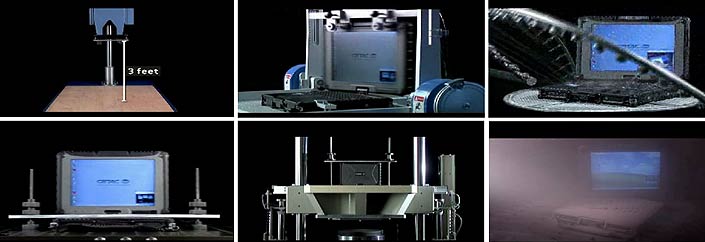
Ingress Protection (IP66). IP ratings define enclosure resistance to solids and liquids. The first digit refers to particulate protection, the second to liquid ingress. An IP66 rating indicates complete protection against dust and resistance to powerful water jets from any direction. In practical terms, the UX10 can be safely rinsed after exposure to dirt or contaminants.
 Temperature, humidity, and altitude. The UX10's wide operating temperature range was validated in accordance with MIL-STD-810 procedures for high- and low-temperature operation. The system also passed non-condensing humidity testing up to 95% relative humidity and is rated for operation at altitudes up to 15,000 feet, including use in pressurized aircraft cabins. Temperature, humidity, and altitude. The UX10's wide operating temperature range was validated in accordance with MIL-STD-810 procedures for high- and low-temperature operation. The system also passed non-condensing humidity testing up to 95% relative humidity and is rated for operation at altitudes up to 15,000 feet, including use in pressurized aircraft cabins.
Shock, vibration, and drop. Mechanical durability is evaluated under MIL-STD-810H methodologies, including vibration and transit drop procedures. While promotional materials summarize this as "vibration and drop resistant," specific test parameters are available through Getac upon request. Transit drop testing under Method 516.8, Procedure IV typically involves 26 drops from four feet — a height approximating a device falling from hand carry. According to Getac, the UX10 has been validated from six feet, exceeding the baseline requirement.
Hazardous location certifications. Getac offers optional ANSI/UL 121201 and CSA C22.2 No. 213 certifications. In addition, the UX10-Ex variant is certified to ATEX and IECEx standards for use in explosive atmospheres. Configuration options are available for deployment in oil and gas, petrochemical, aviation, and related industrial environments.
Chemical resistance and decontamination. Getac publishes a decontamination guidance document (see here) specifying compatible disinfectants. Approved cleaning agents have been tested for durability across 10,000 wipe cycles at a pressure of 14.22 psi.
Security — all the tools are there
Data and access security is becoming an ever more important issue in mobile computing. The UX10 offers TPM 2.0 functionality to store secured information. An optional Smart Card or HF RFID reader provides additional access security. A Kensington-style lock slot can be used to secure the UX10 via a steel cable. Two of the four available processors support vPro, a set of Intel security and remote management technologies that provide multiple lines of built-in defenses (for more detail on implementing vPro features, see Intel's vPro page here). The BIOS is compliant with NIST (National Institute of Standards and Technology) protection guidelines (see here). And the tablet is available with optional Absolute Persistence (Data & Device Security) software, which is an updated version of what used to be known as CompuTrace.
LumiBond display works well indoors and out
Computer display technology has advanced dramatically over the past decades. Indoors, many modern displays appear nearly flawless. Outdoors, however, direct sunlight and surface reflections can overwhelm even very bright panels. For rugged tablets such as the Getac UX10, effective outdoor readability is therefore critical.
Rugged system manufacturers have long competed to refine sunlight-readable display technology. Getac, a long-standing player in the rugged computing space, has focused on four core elements: high-luminance backlighting, anti-reflective surface treatments, linear polarizers, and circular polarizers.
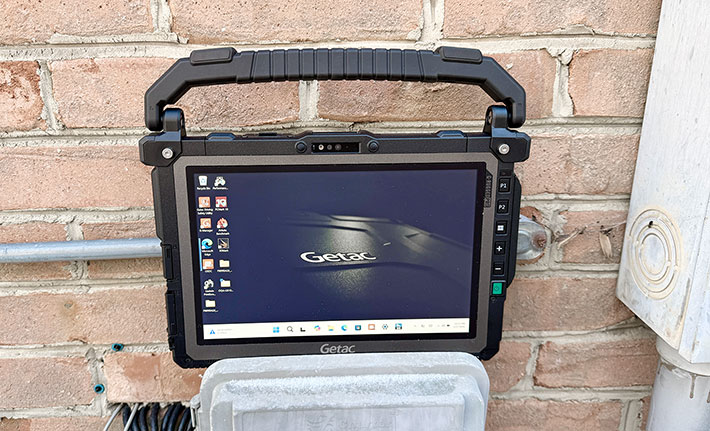
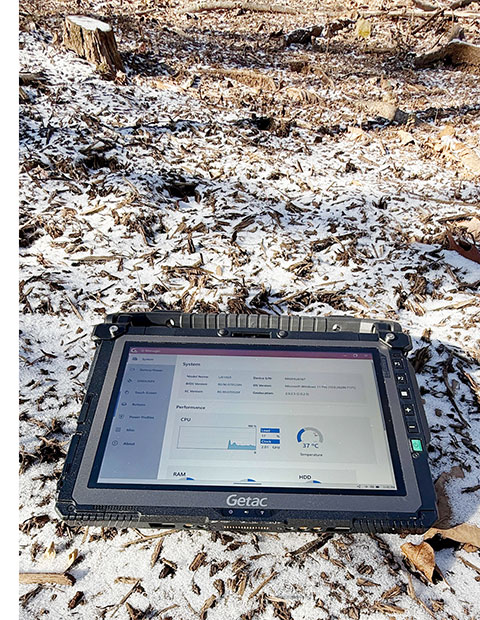
Most manufacturers of outdoor-capable mobile systems employ similar techniques. Differences typically come down to achievable backlight brightness, the quality and extent of optical coatings, and the bonding process used to minimize internal reflections between display layers. Getac refers to its proprietary bonding technology as LumiBond (see LumiBond page), which reduces air gaps and reflective interfaces within the display stack.
Backlight strength is expressed in terms of luminance, measured in candela per square meter (cd/m²). In industry shorthand, this unit is commonly referred to as "nits."
 Standard laptop displays generally range from 200 to 300 nits. Premium consumer tablets often fall in the 400-600 nit range. Some heavy-duty rugged systems reach 1,500 nits, though such brightness levels typically come with increased power consumption. Standard laptop displays generally range from 200 to 300 nits. Premium consumer tablets often fall in the 400-600 nit range. Some heavy-duty rugged systems reach 1,500 nits, though such brightness levels typically come with increased power consumption.
The UX10 display is rated at up to 1,000 nits. Combined with its optical treatments, this brightness level significantly reduces the impact of ambient reflections. Effective outdoor readability depends not only on raw luminance, but on the ratio between emitted backlight and reflected ambient light — a key determinant of perceived contrast under real-world conditions.
Most consumer laptops and tablets use glossy screens to enhance perceived color saturation. While visually striking indoors, glossy panels tend to reflect sharply and can become mirror-like outdoors. The UX10 employs a semi-matte surface treatment that diffuses reflections and significantly improves readability in bright conditions. This remains a key distinction between industrial devices designed for field use and consumer products optimized primarily for indoor environments.
There is, however, no optical "magic." Semi-matte coatings achieve reflection control through light diffusion, which can introduce a slight reduction in perceived contrast or a mild "milkiness" under certain conditions.
The comparison matrix below illustrates the UX10 display under a variety of viewing environments. In practice, the panel performs in line with expectations for a 1,000-nit rugged display.
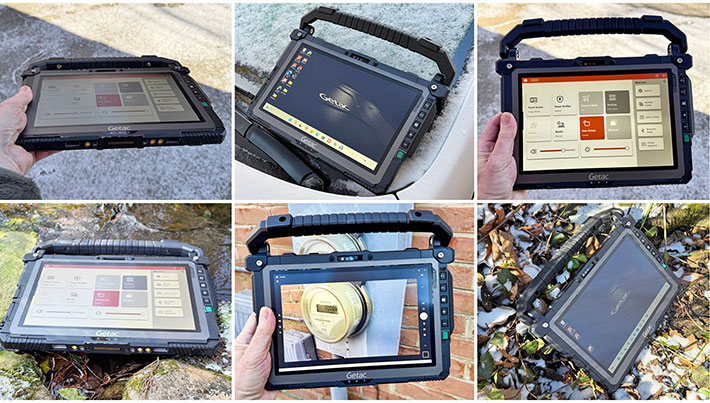
Overall, the UX10's display strikes an effective balance. While both glossy and semi-matte technologies have tradeoffs, in direct sunlight the UX10's approach provides a clear usability advantage. Within its class, performance is competitive and well aligned with field requirements.

OSD Control Panel and G-Manager
In the field, users need quick access to often-used functions and applications, and the quicker and easier it is to find and access those functions, the better. For that reason, Getac included a number of useful utilities. Below are screen shots of four of those utilities:
 - Getac OSD Control Panel — OSD, which stands for On Screen Display, provides quick access to the UX10's major functions.
It can be used to control brightness and sound, activate airplane mode, rotate the screen, bring up an on-screen keyboard, setup Bluetooth, and launch the Mobility Center, camera, keyboard, and web browser.
- Getac Camera — a simple, handy app that lets users control the UX10's integrated camera (or cameras, if the optional documentation camera is also installed). You can set image storage location and naming conventions, brightness, contrast, hue, night mode, capture mode, shutter sound, white balance, and more. You can also get GPS information (if the computer has GPS), view stored images, etc.
- G-Manager — a utility app that provides a system overview, complete battery stats, power plan settings, touch screen configuration, button configuration, docking station configuration, antenna settings, and status monitoring. Below are screen snaps of several G-Manager screens. Click the image for a full-size version.

One of the limiting issues with capacitive multi-touch is that in its generic form, it only works with human fingers or, to a lesser extent, with capacitive styli. Capacitive touch doesn't like rain and it won't accept thick gloves and such. Unfortunately, wetness and the need for gloves is exactly what one encounters out there where machines such as the Getac UX10 are often used.
Getac was one of the first to address these issues, and solutions have been part of the LumiBond technology for several years. There's a special G-Manager "Touch Screen" display where users can select "Touch," "Glove," or "Stylus." Here's how it works:
"Finger Mode" is what you use when you're outdoors and it might rain or there may be some splashing. The screen will respond to fingertips, but not to liquids. However, it will also not respond to the stylus.
"Glove Mode" allows the UX10 to be operated with gloves. That is done by increasing the sensitivity of the touch controller, so that it can recognize a finger even a brief distance away from the screen, as in the distance that the material of a glove adds to the finger's distance from the screen.
"Stylus Mode" mode lets you use the Getac stylus or fingers. If you use both, the smaller touch area of the stylus takes priority over the larger area of a finger tip.
But there's more: Getac also offers an optional dual-mode touchscreen that works with fingers or a special digitizer pen. This pen works better for data entry, handwritten signatures and, presumably, handwriting recognition. Active digitizer pens generally work with an electronic grid behind the LCD to communicate with the tip of the special stylus (which doesn't need a battery). The technology is not only precise, but also works well with legacy Windows applications that tend to have a lot of small check boxes, pulldowns, and similar small items.
Below are the optional Getac digitizer pen (top) and the Getac stylus (bottom). Both are about 4-1/2 inches long.

Overall, capacitive multi-touch performance on the UX10 is solid and responsive, as expected from a modern rugged platform. Finger input works reliably across the interface.
While touch hardware has matured significantly, Windows itself remains primarily optimized for keyboard and mouse interaction. As a result, the overall tablet experience is still influenced more by operating system design than by hardware capability.
The optional active digitizer provides accurate pen input for annotation and documentation tasks. Although pen technology has evolved incrementally over the decades, it continues to serve a practical role in field applications where handwritten input, signatures, or markup are required.
Summary: Getac UX10 rugged tablet
Now in its fifth generation, the Getac UX10 remains a strong contender in the popular 10-inch rugged tablet segment. It further strengthens Getac's increasingly comprehensive portfolio of rugged computing solutions designed for demanding environments.
The UX10 occupies a practical middle ground: larger than even the biggest smartphones, yet compact enough for highly mobile deployments. Equipped with Intel Core Ultra Series 2 "V" processors, it delivers more than ample performance for field applications while maintaining excellent energy efficiency. In our testing, the system achieved over 25 hours of runtime with the optional 99.8Wh battery. The fifth-generation UX10 also qualifies for Microsoft's "Copilot+ PC" designation, meeting the platform requirements for memory, storage, Windows 11, and NPU performance of 40+ TOPS.

Its modular architecture with three expansion areas enables configuration flexibility for a wide range of deployment scenarios. The bright 1,000-nit display supports effective outdoor operation, while an extensive accessory ecosystem facilitates integration in vehicles, field workflows, and office environments. Robust construction and comprehensive certifications underscore its suitability for harsh conditions well beyond the limits of consumer-grade devices.
The UX10 exemplifies the distinction between consumer electronics and purpose-built rugged computing. Its balanced V-series architecture, strong AI acceleration, exceptional energy efficiency, modular expandability, and refined internal engineering position it as a forward-looking platform for demanding field deployments. With this generation, Getac reinforces not only durability and mobility, but also alignment with the evolving direction of edge and AI-enhanced workflows. – Conrad H. Blickenstorfer, February 2026
|
Getac UX10 G5 Specifications
|
| Status |
Announced Fall 2025, full review February 2026
|
| Type |
Fully rugged tablet
|
| Processor |
Intel Core Ultra 7 268V (5.0 GHz max turbo, 118 overall peak TOPS)
Intel Core Ultra 7 266V (5.0 GHz max turbo, 118 overall peak TOPS)
Intel Core Ultra 7 258V (4.8 GHz max turbo, 115 overall peak TOPS)
Intel Core Ultra 7 256V (4.8 GHz max turbo, 115 overall peak TOPS)
Intel Core Ultra 5 238V (4.7 GHz max turbo, 97 overall peak TOPS)
Intel Core Ultra 5 236V (4.7 GHz max turbo, 97 overall peak TOPS)
Intel Core Ultra 5 228V (4.5 GHz max turbo, 97 overall peak TOPS)
Intel Core Ultra 5 226V (4.5 GHz max turbo, 97 overall peak TOPS)
|
| Thermal Design Power |
17/37 watts (all available processors)
|
| Graphics |
Ultra 7 processors: Intel Arc 140V
Ultra 5 processors: Intel Arc 130V
|
| OS |
Windows 11 Pro
|
| Memory |
16GB or 32GB 5600MHz LPDDR5x memory on package
|
| Storage |
256GB / 512GB / 1TB / 2TB PCIe NVMe SSD, M.2 2280 form factor
|
| Expansion slots |
Optional: 1 x SIM card slot x 1 Micro-SIM, 3FF
|
| Display type |
Wide Viewing Angle TFT LCD, LumiBond sunlight readable display |
| Display size/res |
10.1"/1920 x 1200 pixel (224 ppi) 1000 NITs
|
| Digitizer |
10-point capacitive multi-touch, hard tip stylus; optional digitizer |
| Keyboard |
Optional full-size 82-key backlit detachable mechanical keyboard |
| Housing |
ABD + PC polymer over magnesium frame |
| Size |
Tablet: 10.98 x 7.65 x 0.92 inches (279 x 195 x 24 mm)
Tablet + Kbd: 11.77 x 10.43 x 1.92 inches (299 x 265 x 49 mm)
|
| Weight |
Tablet: 2.53 pounds (1.15 kg)
Tablet + Kbd: 5.00 pounds (2.25 kg)
|
| Operating temperature |
-25° to 145°F (-31° to 63°C) |
| Drop test |
MIL-STD-810G Method 516.6 -- transit drop: 26 drops from 6 feet |
| Ingress protection |
IP66 |
| Vibration |
"Vibration & drop resistant" |
| Humidity |
95% RH, non-condensing
|
| Disinfectants |
See Getac rugged mobile computer decontamination
|
| Intrinsic safety |
Getac offers the UX10-Ex for use in explosive atmospheres (ATEX / IECEx Zone 2/22, II3GExicopisIICT4Gc, II3DExicopisIIIBT130°CDc)
|
| Power |
11.61V 4,070 mAH 47.25Wh Li-Ion batteries; optional 10.8V 9,240 mAH 99.8Wh Li-Ion battery, optional bridge battery
|
| Cameras |
Front-facing: 5MP Windows Hello face-authentication camera; rear-facing: 13MP AF camera
|
| Data collection |
Top: optional 1D/2D imager barcode reader; Right side: optional fingerprint reader, or serial port+LAN port (RJ-45); Back side: optional Smart card reader OR Bridge battery
|
| Security |
Intel vPro (per CPU options), TPM 2.0, cable lock slot, NIST BIOS compliant; optional Absolute Persistance software, optional Smart Card reader, fingerprint reader, HF RFID reader
|
| Interface |
DC-in jack, 1 x USB 3.2 Gen 2 Type-A, 2 x Thunderbolt 4 Type-C, Docking connector'
optional: SIM card slot x 1 (Micro-SIM, 3FF), RF antenna pass-through for GPS,
WWAN and WLAN
Optional keyboard dock:
1 x USB 2.0
1 x HDMI 2.0
1 x LAN (RJ45)
1 x serial port (9-pin; D-sub)
DC-in Jack
|
| Wireless |
Intel Wi-Fi 7 BE201, 802.11be, Bluetooth 5.4; optional dedicated GNSS with L1/L5, optional 4G LTE with integrated GPS, optional 5G Sub-6 with integrated L1 GNSS
|
| Price |
Inquire |
| Web page |
Getac UX10 web page
|
| Brochure |
 Getac UX10 spec page Getac UX10 spec page
|
| Warranty |
3-year bumper-to-bumper warranty standard |
|
|
|
|


